Experimental performance of a multi-storey braced frame structure with non-structural industrial components subjected to synthetic ground motions

Mai 5, 2022·· Earthquake Engineering & Structural Dynamics, 51(9), 2113–2136 · 2 Min Lesezeit
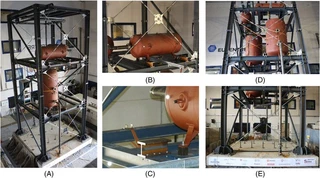
The braced frame configuration tested at EUCENTRE (from the article)
Zusammenfassung
The seismic risk assessment of industrial facilities mainly relies on historical data and the analysis and design of uncoupled secondary components. Accordingly, the dynamic interaction between primary structures and process equipment is overlooked. The SPIF project - Seismic Performance of Multi-Component Systems in Special Risk Industrial Facilities - was carried out to respond to this gap, within the European H2020 SERA framework. Its objective regarded the investigation of the seismic behaviour of an archetype industrial multi-storey steel moment resisting frame (MRF) structure equipped with non-structural components (NSCs) by means of shaking table tests. The goal of the proposed study was to extend the interaction analysis between a primary multi-storey braced frame (BF) steel structure and NSCs in a performance-based earthquake engineering (PBEE) perspective. Along this vein, to excite the vibration periods of the NSCs and thus enhance possible coupling with the primary structure, a synthetic site-based ground motion model (GMM) was employed. More precisely, the proposed research intended: (i) to severely excite the process equipment and supplement the scarcity of real records with a specific frequency content by means of a stochastic GMM; (ii) to quantify seismic-induced force and displacement demands of secondary components and their effects on the primary BF structure. The evaluation of the experimental data clearly shows buckling in the bracing system of the BF configuration and a strong interaction between vertical tanks and floor crossbeams of the BF. At the very least, the favourable performance of the archetype BF under strong seismic records is demonstrated.
publication
Abstract

The seismic risk assessment of industrial facilities mainly relies on historical data and the analysis and design of uncoupled secondary components. Accordingly, the dynamic interaction between primary structures and process equipment is overlooked. The SPIF project - Seismic Performance of Multi-Component Systems in Special Risk Industrial Facilities - was carried out to respond to this gap, within the European H2020 SERA framework. Its objective regarded the investigation of the seismic behaviour of an archetype industrial multi-storey steel moment resisting frame (MRF) structure equipped with non-structural components (NSCs) by means of shaking table tests. The goal of the proposed study was to extend the interaction analysis between a primary multi-storey braced frame (BF) steel structure and NSCs in a performance-based earthquake engineering (PBEE) perspective. Along this vein, to excite the vibration periods of the NSCs and thus enhance possible coupling with the primary structure, a synthetic site-based ground motion model (GMM) was employed. More precisely, the proposed research intended: (i) to severely excite the process equipment and supplement the scarcity of real records with a specific frequency content by means of a stochastic GMM; (ii) to quantify seismic-induced force and displacement demands of secondary components and their effects on the primary BF structure. The evaluation of the experimental data clearly shows buckling in the bracing system of the BF configuration and a strong interaction between vertical tanks and floor crossbeams of the BF. At the very least, the favourable performance of the archetype BF under strong seismic records is demonstrated.

Tipp

Click the Cite button above to copy .bib publication metadata into your notes. or directly download here either the bibtex version: Download BibTeX or the plain text one: Download Plain.txt

Chiara Nardin
Autoren
MSCA-Postdoktorandin an der ETH Zürich (Schweiz) und der Universität Trient (Italien)
Bauingenieurin und MSCA-Fellow. Ich forsche zu Erdbebenrisiko, Fragilitätsmodellierung und Unsicherheitsquantifizierung für komplexe Industrieanlagen an der ETH Zürich und der Universität Trient.
Oreste S. Bursi
Autoren
Oreste S. Bursi
Full Professor at University of Trento (Italy)
Fabrizio Paolacci
Autoren
Fabrizio Paolacci
Full Professor at Roma Tre University (Italy)
Alberto Pavese
Autoren
Alberto Pavese
Associate Professor at University of Pavia (Italy)
Gianluca Quinci
Autoren
Gianluca Quinci
Assistant Professor at Roma Tre University (Italy)