Experimental investigation on the seismic performance of a multi-component system for major-hazard industrial facilities

Juli 13, 2021·· Proceedings of the ASME 2021 Pressure Vessels & Piping Conference (PVP2021), Vol. 5, V005T08A016 · 2 Min Lesezeit
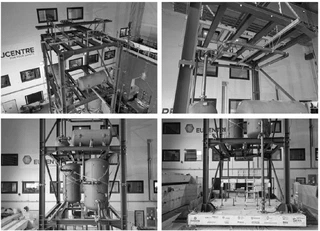
Mock-up photographs at the EUCENTRE laboratory (from the paper)
Zusammenfassung
Past earthquakes demonstrated the high vulnerability of industrial facilities equipped with complex process technologies leading to serious damage of the process equipment and multiple and simultaneous release of hazardous substances in industrial facilities. Nevertheless, the design of industrial plants is inadequately described in recent codes and guidelines, as they do not consider the dynamic interaction between the structure and the installations and thus the effect of seismic response of the installations on the response of the structure and vice versa. The current code-based approach for the seismic design of industrial facilities is considered not enough for ensure proper safety conditions against exceptional event entailing loss of content and related consequences. Accordingly, SPIF project (Seismic Performance of Multi-Component Systems in Special Risk Industrial Facilities) was proposed within the framework of the European H2020 - SERA funding scheme (Seismology and Earthquake Engineering Research Infrastructure Alliance for Europe). The objective of the SPIF project is the investigation of the seismic behaviour of a representative industrial structure equipped with complex process technology by means of shaking table tests. The test structure is a three-story moment resisting steel frame with vertical and horizontal vessels and cabinets, arranged on the three levels and connected by pipes. The dynamic behaviour of the test structure and of its relative several installations is investigated. Furthermore, both process components and primary structure interactions are considered and analyzed. Several PGA-scaled artificial ground motions are applied to study the seismic response at different levels. After each test, dynamic identification measurements are carried out to characterize the system condition. The contribution presents the experimental setup of the investigated structure and installations, selected measurement data and describes the obtained damage. Furthermore, important findings for the definition of performance limits, the effectiveness of floor response spectra in industrial facilities will be presented and discussed.
publication
Abstract

Past earthquakes demonstrated the high vulnerability of industrial facilities equipped with complex process technologies leading to serious damage of the process equipment and multiple and simultaneous release of hazardous substances in industrial facilities. Nevertheless, the design of industrial plants is inadequately described in recent codes and guidelines, as they do not consider the dynamic interaction between the structure and the installations and thus the effect of seismic response of the installations on the response of the structure and vice versa. The current code-based approach for the seismic design of industrial facilities is considered not enough for ensure proper safety conditions against exceptional event entailing loss of content and related consequences. Accordingly, SPIF project (Seismic Performance of Multi-Component Systems in Special Risk Industrial Facilities) was proposed within the framework of the European H2020 - SERA funding scheme (Seismology and Earthquake Engineering Research Infrastructure Alliance for Europe). The objective of the SPIF project is the investigation of the seismic behaviour of a representative industrial structure equipped with complex process technology by means of shaking table tests. The test structure is a three-story moment resisting steel frame with vertical and horizontal vessels and cabinets, arranged on the three levels and connected by pipes. The dynamic behaviour of the test structure and of its relative several installations is investigated. Furthermore, both process components and primary structure interactions are considered and analyzed. Several PGA-scaled artificial ground motions are applied to study the seismic response at different levels. After each test, dynamic identification measurements are carried out to characterize the system condition. The contribution presents the experimental setup of the investigated structure and installations, selected measurement data and describes the obtained damage. Furthermore, important findings for the definition of performance limits, the effectiveness of floor response spectra in industrial facilities will be presented and discussed.

Tipp

Click the Cite button above to copy .bib publication metadata into your notes. or directly download here either the bibtex version: Download BibTeX or the plain text one: Download Plain.txt

Christoph Butenweg
Autoren
Christoph Butenweg
Professor at FH Aachen University of Applied Sciences (Germany)
Oreste S. Bursi
Autoren
Oreste S. Bursi
Full Professor at University of Trento (Italy)
Chiara Nardin
Autoren
MSCA-Postdoktorandin an der ETH Zürich (Schweiz) und der Universität Trient (Italien)
Bauingenieurin und MSCA-Fellow. Ich forsche zu Erdbebenrisiko, Fragilitätsmodellierung und Unsicherheitsquantifizierung für komplexe Industrieanlagen an der ETH Zürich und der Universität Trient.
Igor Lanese
Autoren
Igor Lanese
Scientific Responsible, 6D Shaking Table at EUCENTRE (Italy)
Alberto Pavese
Autoren
Alberto Pavese
Associate Professor at University of Pavia (Italy)
Marko Marinković
Autoren
Marko Marinković
Associate Professor at University of Belgrade (Serbia)
Fabrizio Paolacci
Autoren
Fabrizio Paolacci
Full Professor at Roma Tre University (Italy)
Gianluca Quinci
Autoren
Gianluca Quinci
Assistant Professor at Roma Tre University (Italy)