State-dependent seismic fragility functions for vertical tanks installed on major hazard industrial substructure module

lug 1, 2024·,,· 18th World Conference on Earthquake Engineering (WCEE 2024), Milan, Italy · 1 min di lettura
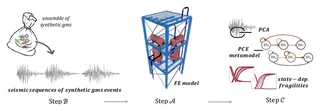
State-dependent fragility analysis UQ-based framework (from the paper)
Abstract
Seismic vulnerability assessment of industrial plants and process equipment has gained attention lately. However, the complexity of the problem and its modelling, combined with a general scarcity of available data on industrial systems, contributed to limiting or developing risk assessment methods based on extremely simplified models. On these premises, a new methodology that combines limited data from finite element (FE) models with cutting-edge machine learning techniques is developed to generate state-dependent fragility functions for critical components mounted on archetypical industrial substructure modules. Specifically, referring to the classical forward uncertainty quantification scheme, a physics-informed FE model, calibrated on the results of a comprehensive shake table test campaign of a real-scale industrial braced-frame (BF) steel substructure, is considered. Time histories of seismic event sequences generated by a site-based ground motion model compose the input provided to the FE model. The uncertainty is then propagated through Monte Carlo analysis on inexpensive-to-run polynomial chaos expansion (PCE) metamodels set for each starting damage level condition measure. As a result, empirical state-dependent fragilities are evaluated, assuming the lognormal distribution.
publication
Abstract

Seismic vulnerability assessment of industrial plants and process equipment has gained attention lately. However, the complexity of the problem and its modelling, combined with a general scarcity of available data on industrial systems, contributed to limiting or developing risk assessment methods based on extremely simplified models. On these premises, a new methodology that combines limited data from finite element (FE) models with cutting-edge machine learning techniques is developed to generate state-dependent fragility functions for critical components mounted on archetypical industrial substructure modules. Specifically, referring to the classical forward uncertainty quantification scheme, a physics-informed FE model, calibrated on the results of a comprehensive shake table test campaign of a real-scale industrial braced-frame (BF) steel substructure, is considered. Time histories of seismic event sequences generated by a site-based ground motion model compose the input provided to the FE model. The uncertainty is then propagated through Monte Carlo analysis on inexpensive-to-run polynomial chaos expansion (PCE) metamodels set for each starting damage level condition measure. As a result, empirical state-dependent fragilities are evaluated, assuming the lognormal distribution.

Suggerimento

Click the Cite button above to copy .bib publication metadata into your notes. or directly download here either the bibtex version: Download BibTeX or the plain text one: Download Plain.txt

Chiara Nardin
Autori
Ricercatrice postdoc MSCA all’ETH di Zurigo (Svizzera) e all’Università di Trento (Italia)
Ingegnera strutturista e borsista MSCA: mi occupo di rischio sismico, modellazione della fragilità e quantificazione dell’incertezza per sistemi industriali complessi, all’ETH di Zurigo e all’Università di Trento.
Oreste S. Bursi
Autori
Oreste S. Bursi
Full Professor at University of Trento (Italy)
Marco Broccardo
Autori
Marco Broccardo (he/him)
Associate Professor at University of Trento (Italy)
Autori
Stefano Marelli (he/him)
Senior researcher at ETH Zurich (Switzerland) in the Chair of Risk, Safety and Uncertainty Quantification (RSUQ)
Autori
Bruno Sudret (he/him)
Full Professor at ETH Zurich (Switzerland) in the Chair of Risk, Safety and Uncertainty Quantification (RSUQ)