Seismic performance of an industrial multi-storey frame structure with process equipment subjected to shake table testing

Sep 1, 2021·· Engineering Structures, 243, 112681 · 2 min read
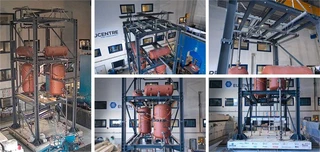
The SPIF MRF test structure with process equipment at EUCENTRE (from the article)
Abstract
Past earthquakes demonstrated the high vulnerability of industrial facilities equipped with complex process technologies leading to serious damage of process equipment and multiple and simultaneous release of hazardous substances. Nonetheless, current standards for seismic design of industrial facilities are considered inadequate to guarantee proper safety conditions against exceptional events entailing loss of containment and related consequences. On these premises, the SPIF project - Seismic Performance of Multi-Component Systems in Special Risk Industrial Facilities - was proposed within the framework of the European H2020 SERA funding scheme. In detail, the objective of the SPIF project is the investigation of the seismic behaviour of a representative industrial multi-storey frame structure equipped with complex process components by means of shaking table tests. Along this main vein and in a performance-based design perspective, the issues investigated in depth are the interaction between a primary moment resisting frame (MRF) steel structure and secondary process components that influence the performance of the whole system; and a proper check of floor spectra predictions. The evaluation of experimental data clearly shows a favourable performance of the MRF structure, some weaknesses of local details due to the interaction between floor crossbeams and process components and, finally, the overconservatism of current design standards w.r.t. floor spectra predictions.
publication
Abstract

Past earthquakes demonstrated the high vulnerability of industrial facilities equipped with complex process technologies leading to serious damage of process equipment and multiple and simultaneous release of hazardous substances. Nonetheless, current standards for seismic design of industrial facilities are considered inadequate to guarantee proper safety conditions against exceptional events entailing loss of containment and related consequences. On these premises, the SPIF project - Seismic Performance of Multi-Component Systems in Special Risk Industrial Facilities - was proposed within the framework of the European H2020 SERA funding scheme. In detail, the objective of the SPIF project is the investigation of the seismic behaviour of a representative industrial multi-storey frame structure equipped with complex process components by means of shaking table tests. Along this main vein and in a performance-based design perspective, the issues investigated in depth are the interaction between a primary moment resisting frame (MRF) steel structure and secondary process components that influence the performance of the whole system; and a proper check of floor spectra predictions. The evaluation of experimental data clearly shows a favourable performance of the MRF structure, some weaknesses of local details due to the interaction between floor crossbeams and process components and, finally, the overconservatism of current design standards w.r.t. floor spectra predictions.

Tip

Click the Cite button above to copy .bib publication metadata into your notes. or directly download here either the bibtex version: Download BibTeX or the plain text one: Download Plain.txt

Christoph Butenweg
Authors
Christoph Butenweg
Professor at FH Aachen University of Applied Sciences (Germany)
Oreste S. Bursi
Authors
Oreste S. Bursi
Full Professor at University of Trento (Italy)
Fabrizio Paolacci
Authors
Fabrizio Paolacci
Full Professor at Roma Tre University (Italy)
Marko Marinković
Authors
Marko Marinković
Associate Professor at University of Belgrade (Serbia)
Igor Lanese
Authors
Igor Lanese
Scientific Responsible, 6D Shaking Table at EUCENTRE (Italy)
Chiara Nardin
Authors
MSCA PostDoc at ETH Zurich (Switzerland) and UniTn (Italy)
Structural engineer and MSCA fellow working on seismic risk, fragility modelling, and uncertainty quantification for complex industrial systems at ETH Zurich and the University of Trento.
Gianluca Quinci
Authors
Gianluca Quinci
Assistant Professor at Roma Tre University (Italy)