Ground motion model for seismic vulnerability assessment of prototype industrial plants

 from the article
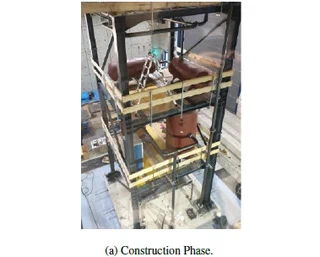
Relationships between seismic action, system response and relevant damage levels in industrial plants require a solid background both in experimental data, due to the high level of nonlinearity and seismic input. Besides, risk and fragility analyses depend on the adoption of a huge number of seismic records usually not available in a site-specific analysis. In order to manage these issues and to gain knowledge on the definition of damage levels, limit states and performance for major-hazard industrial plant components, we present a possible approach for an experimental campaign based on a real prototype industrial steel structure. The investigation of the seismic behaviour of the reference structure will be carried out through shaking table tests. In particular, tests are focused on structural or process-related interactions that can lead to serious secondary damages as leakage in piping systems or connections with tanks and cabinets. The aforementioned test program has been possible thanks to the adoption of: (i) a number of artificial spectrum-compatible accelerograms; (ii) a ground motion model (GMM) able to generate a suite of synthetic time-histories records for specified site characteristic and earthquake scenarios. More precisely, GMM model parameters can be identified by matching the statistics of a target-recorded accelerogram to the ones of the model in terms of faulting mechanism, earthquake magnitude, source-to-site distance and site shear-wave velocity. As a result, the stochastic model, based both on these matched parameters and on filtered white-noise process, can generate the ensemble of synthetic ground motions capable of capturing the main features of real earthquake ground motions, including intensity, duration, spectral content and peak values. Moreover, the synthetic records are selected to target specific damages and limit states in industrial components. Finally, by means of the combination of artificial and synthetic accelerograms, a seismic vulnerability assessment of both the whole structure and relevant industrial components
Click the Cite button above to copy .bib publication metadata into your notes.
or directly download here either the bibtex version:
Download BibTeX
or the plain text one:
Download Plain.txt
