Shake table testing for a multi-component prototype industrial plant: input and system modelling issues

Jul 13, 2021·· Proceedings of the ASME 2021 Pressure Vessels & Piping Conference (PVP2021), Vol. 5, V005T08A017 · 2 min read
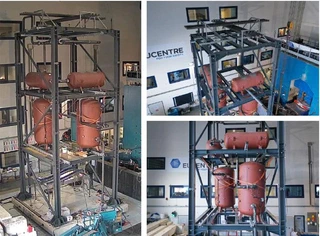
Mock-up photographs at the EUCENTRE laboratory (from the paper)
Abstract
Recent destructive earthquakes in China (Sichuan, 2008 and Yushu, 2010), Japan (Tohoku, 2011) and Italy (Emilia, 2012) highlighted the social and the political consequences of seismic risk due especially to industrial facilities. More precisely, critical interactions between the supporting structure and process components reveal to be extremely vulnerable in a seismic scenario and capable to lead serious damage of process equipment and potential release of hazardous substances. This latter circumstance, underestimated by current codes, in addition to loss of production, pose a serious danger to humans and the surrounding environment. Based on these premises, the SPIF project - Seismic Performance of Multi-Component Systems in Special Risk Industrial Facilities - was proposed within the framework of the European H2020 - SERA funding scheme. In greater detail, the goal of the project is the investigation of both the seismic behavior and the dynamic interactions of a representative industrial substructure equipped with complex process technology by means of shaking table tests. A full-scale mock-up composed by two single-bay moment resisting frames with three floors equipped with tanks, flanges, pipes, cabinet etc. was built and tested using a unidirectional shaking table activated with several earthquake levels. More precisely, the salient features investigated by shaking table testing are: i) the interaction between a primary moment resisting frame steel structure and secondary process components that influence the performance of the whole system; ii) input and system modelling capable to faithfully reproduce the seismic response of SPIF tested structure. The comprehensive testing campaign demonstrated a clear dynamic interaction between the primary steel structure and secondary process units that emphasizes the need of further investigations and studies.
publication
Abstract

Recent destructive earthquakes in China (Sichuan, 2008 and Yushu, 2010), Japan (Tohoku, 2011) and Italy (Emilia, 2012) highlighted the social and the political consequences of seismic risk due especially to industrial facilities. More precisely, critical interactions between the supporting structure and process components reveal to be extremely vulnerable in a seismic scenario and capable to lead serious damage of process equipment and potential release of hazardous substances. This latter circumstance, underestimated by current codes, in addition to loss of production, pose a serious danger to humans and the surrounding environment. Based on these premises, the SPIF project - Seismic Performance of Multi-Component Systems in Special Risk Industrial Facilities - was proposed within the framework of the European H2020 - SERA funding scheme. In greater detail, the goal of the project is the investigation of both the seismic behavior and the dynamic interactions of a representative industrial substructure equipped with complex process technology by means of shaking table tests. A full-scale mock-up composed by two single-bay moment resisting frames with three floors equipped with tanks, flanges, pipes, cabinet etc. was built and tested using a unidirectional shaking table activated with several earthquake levels. More precisely, the salient features investigated by shaking table testing are: i) the interaction between a primary moment resisting frame steel structure and secondary process components that influence the performance of the whole system; ii) input and system modelling capable to faithfully reproduce the seismic response of SPIF tested structure. The comprehensive testing campaign demonstrated a clear dynamic interaction between the primary steel structure and secondary process units that emphasizes the need of further investigations and studies.

Tip

Click the Cite button above to copy .bib publication metadata into your notes. or directly download here either the bibtex version: Download BibTeX or the plain text one: Download Plain.txt

Chiara Nardin
Authors
MSCA PostDoc at ETH Zurich (Switzerland) and UniTn (Italy)
Structural engineer and MSCA fellow working on seismic risk, fragility modelling, and uncertainty quantification for complex industrial systems at ETH Zurich and the University of Trento.
Oreste S. Bursi
Authors
Oreste S. Bursi
Full Professor at University of Trento (Italy)
Fabrizio Paolacci
Authors
Fabrizio Paolacci
Full Professor at Roma Tre University (Italy)
Gianluca Quinci
Authors
Gianluca Quinci
Assistant Professor at Roma Tre University (Italy)
Igor Lanese
Authors
Igor Lanese
Scientific Responsible, 6D Shaking Table at EUCENTRE (Italy)
Alberto Pavese
Authors
Alberto Pavese
Associate Professor at University of Pavia (Italy)